
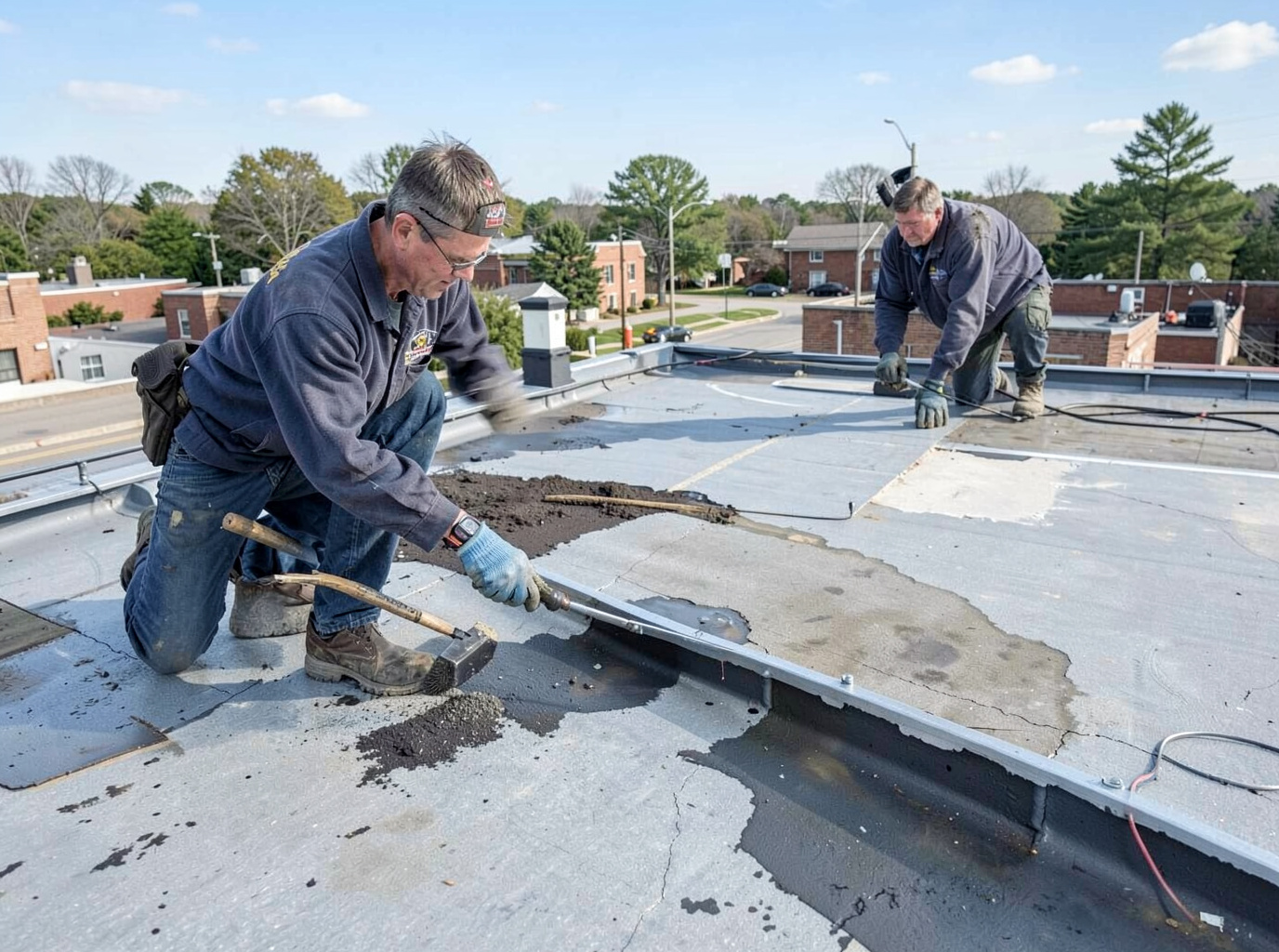
Commercial buildings in Downtown Muncie and the Old West End often feature older flat roof assemblies that were installed before current energy codes, making them prone to seam failure when temperatures swing from humid summer highs into freezing winter lows. Standing water collects near scuppers and drains during heavy rains common in Delaware County, accelerating blistering on modified bitumen and EPDM systems. A roofing contractor working these blocks sees the same pattern repeatedly: foot traffic from HVAC maintenance combined with UV exposure cracks the surface, and small punctures turn into larger leaks once ice forms along the edges.
Near Ball State University and along Riverside, many commercial structures sit on lots with limited slope, so even minor membrane shrinkage from cold contraction creates ponding that ice and snow load then push deeper into the insulation. Repair crews must match existing TPO or built-up layers exactly or the patch will telegraph movement when the next heat wave arrives. Local contractors also watch for rust at metal edge details on Westside properties where de-icing salts from nearby streets accelerate deterioration.
Repairs in East Central Muncie require attention to code requirements for fire-rated assemblies on buildings close to property lines. Crews typically remove saturated insulation sections rather than simply overlaying new membrane, because trapped moisture will blister through again once summer heat returns. Proper tie-in to existing flashings at parapets and penetrations prevents the wind-driven rain that Delaware County storms push under loose edges.
Technician insight
In Muncie, the thing that catches most people out with Commercial Flat Roof Repair is how quickly cold winters turn small seam splits into major leaks once ice forms along the edges of older flat roofs downtown and in the Old West End. Many owners wait until summer heat returns before calling, but by then water has already reached the deck on buildings near Ball State University.
Ponding repair on Riverside commercial building
A flat roof on a small commercial property near Riverside showed repeated leaks after winter storms. Inspection found clogged scuppers and blistered membrane sections holding water. Crews cleared the drains, replaced the damaged insulation and membrane patches, and restored positive flow to the edges. No further leaks occurred through the following summer.
Commercial Flat Roof Repair Services We Offer
✓Membrane Patching and Seaming
Locate and replace failed sections of EPDM or TPO on commercial flat roofs while heat-welding new seams to prevent water entry during Muncie winters.
✓Drain and Scupper Clearing
Clear debris and repair internal drains on flat roofs in Downtown Muncie and near Minnetrista to stop ponding that freezes and stresses the membrane.
✓Coating Restoration
Apply reflective elastomeric coatings over existing modified bitumen systems to reduce heat gain on buildings around Ball State University during hot summers.
✓Flashing and Edge Detail Repair
Replace deteriorated metal edge flashing and counterflashing on commercial roofs in the Old West End to block wind-driven rain common in Delaware County.
✓Blister and Delamination Repair
Cut out and re-adhere blistered areas on flat roofs serving Westside and East Central commercial properties before they open during freeze-thaw cycles.
Commercial Flat Roof Repair Cost in Muncie, IN
| Service | Typical Range | What Affects It |
|---|---|---|
| Small membrane patch repair | $650–$1,400 | Price moves with square footage and whether wet insulation must be replaced. |
| Drain or scupper repair | $450–$950 | Depends on internal versus external drain type and debris volume. |
| Full coating restoration | $2.25–$3.75 per sq ft | Varies by existing surface condition and number of coats required. |
| Edge flashing replacement | $18–$32 per linear ft | Affected by metal type and height of parapet walls. |
Ranges are typical for Muncie, IN and confirmed with an exact written quote before any work starts.
How it works
- 1
Site Assessment
Walk the roof and document existing membrane type, slope, drain locations, and any visible damage while noting nearby landmarks such as Ball State University buildings.
- 2
Moisture Mapping
Use infrared scanning to identify wet insulation sections that must be removed before new material is installed.
- 3
Material Preparation
Select compatible membrane patches or coatings that match the existing system and will handle Delaware County temperature extremes.
- 4
Repair Execution
Remove damaged sections, install new membrane or coating, and seal all seams and flashings to restore watertight performance.
- 5
Final Walk And Documentation
Inspect completed work, photograph tie-ins, and provide the building owner with a written summary of repairs performed.
Pricing
Pricing varies by roof size, existing membrane condition, and access constraints typical of older commercial buildings in Muncie.